Saturday, October 4, 2008

Bionic Commando : Rearmed


Bionic Commando : Rearmed: A remake of the 2D side-scroller Bionic Commando, a game that earned notoriety more for its need to be different for the sake of being different than anything particularly memorable or great.

Story : Some kind of Nazi faction is building some kind of ancient weapon, all the while kidnapping the ingeniously named soldier “Super Joe” and you, the player, control the equally well-named “Rad Spencer” on his journey to rescue him. For what its worth, the dialogue is more interesting that you’d expect out of such a simple story, despite Rad’s affection for sodomy.

Meet the latest installment in a growing trend in video games – the game designed to promote another game. Joining the ranks of Fable 2 : Pub Games and the Spore Creature Creator, Bionic Commando : Rearmed exists in part to remind players that Capcom is producing a newer, bigger Bionic Commando game in the near future, and to make players think that this is a franchise with a deep and celebrated history. Whether the latter part is true is another question, as the NES game that inspires it is more celebrated for its grappling arm gimmick than anything else.

I’m not quite too sure if the original game is “celebrated” much to begin with to tell the truth.

To its credit, Bionic Commando : Rearmed acknowledges that it’s a remake of an old NES title, a game that clearly didn’t have too much thought put into it aside from “create a guy with an arm that shoots people.” Between the assortment of self-referential jokes in the writing, the use of sprites from the old game scattered around and a soundtrack that remixes the original MIDI tracks with different techno beats, you can’t say that Rearmed isn’t pretending to be anything more than a loving homage to a game from a long forgotten era.

The game expands on the original’s gameplay ideas by adding more types of enemies, a variety of weapons to use to make, and a small handful of original bosses. These help to make the game a bit more forgiving and interesting than its predecessor. However, the functionality behind Bionic Commando’s single unique gameplay mechanic and center of existence remains intact – that your character has a grappling hook arm that clearly weighs so much that asking him to leap or even climb above standard obstacles like the 2-feet-tall barrel is asking for too much out of him. No, instead you kind of have to “swing through” inanimate objects in a clear case of the player having to accept the game’s bizarre laws of nature.

Pretty much every pro and con about the core gameplay rests on this grappling hook and the unusual learning curve it possesses. Controlling the hook and how you swing presents its own set of rules too – you’d think that pointing the analog stick or d-pad in a direction would either fire the hook in a specified direction or extend or detract the cable on your hook, but the controls lose any sense of logic in favor of staying true to its unorthodox original. By default, Rad attempts to fire in a diagonal direction but move the stick and he’ll fire anywhere but. This problem is amplified by the genuinely bad controls that won’t always pick the right direction that you were originally aiming for, causing you to misfire your hook in the wrong direction and fall to your doom.

It’s not that the whole grappling hook mechanic is a bad one, it’s just that the source of the game’s challenge comes more from this, and more from what would otherwise be primitive platforming scenarios than from anything else. The few moments where you’re navigating giant pits by skillfully aiming your hook at certain ceiling spots thrills the player with the feeling of being Cyborg Spiderman. However, most sequences will involve, say, two platforms appearing close together, with just a small space of distance between them that appears on a weird angle. This otherwise odd threat presents an unlikely challenge that could cost you a few lives as you attempt to hope the 360 controller picks up on the right directions you were aiming at and lets you make the precise shots needed to grapple across such a petty gap.

Oh, and you have a set number of lives to beat a level. I tend to think that this old school idea isn’t as outdated as most people think, being that I like games where practice is rewarded with progression. But the game’s challenge comes not from any particular enemy or even a tricky platforming sequence, but rather from the controls and trying to not only figure out how to get the grappling hook to fire where you want it to fire, but hope that the controller clues in on your intention for the hook. I don’t consider fighting the controls to be a good kind of challenge; so ultimately, Rearmed doesn’t provide what I look for in a game of this genre. There seems to be some kind of resurgence of 2D platformers on the handheld systems and digital distribution services like the Xbox Live Arcade, meaning there’s no shortage of ways to feel nostalgic leaping over bottomless pits and stomping goomba-or-goomba-like creatures (thank you Braid), so Rearmed doesn’t feel as novel as it might have been 2 years ago. Hardcore fans of Bionic Commando may want to pick this up to see their gem revived with new graphics, as well as new challenge scenarios to test their mettle, and it’s certainly better than most downloadable games, but this is a game that leaves me wondering why this franchise needed to be resuscitated.

Pros : Entertaining boss fights.

Cons : You’ll repeat most of them twice over.

3 stars

And if you really want the thrill of swinging around, try hunting down the Game Boy Color installment of Bionic Commando.

The World Ends With You


The World Ends With You : A Japanese Role-Playing Game where fashion-aficionados battle supernatural demons in a fight for their unappreciated lives.

Story : Neku is a world-loathing lonely boy who, despite presumably having rich parents based on his attire, hates the world, himself and the general idea of being alive. One day he finds the world littered with demons and himself unable to communicate to most actual people, and has seven days to accomplish a series of tasks laid out for him by some bad people or else himself and several others will DIE. The problem with this story lies in how much of a crybaby Neku is. We’ve seen emo-oriented protagonists in JRPGs in the past but none of them quite compare to this guy, who seemingly just wants to stick his head between his knees and pretend that demons aren’t trying to end him, despite him having some kind of superpowers that allow him to plow through any number of giant sasquatchs creatures. It’s one thing to create a reluctant hero, but for the first 3 chapters, this guy resists every single attempt to do anything redeemable, despite his and other people’s lives being on the line, and in fact he makes a few incredibly bone-headed decisions that the player is helplessly and frustratingly forced to watch while stabbing the touch screen hoping he’ll either snap out of it or die and let the player control someone a little less sappy and hopeless. The plot in general presumably follows most JRPG conventions, with the hero learning the value of life and friendship and trouncing the evil-doers, no doubt unlocking some kind of shocking secret about himself to his allies along the way. I wouldn’t know. Neku wanted the world to leave him alone and I decided to give the man what he wanted by returning the game.

Normally, I like it when a game tries to be different and original, and that looks to be what Square-Enix was aiming to do with The World Ends With You. At the same time, this effort looks to be an attempt to reach out to a certain audience. The specific target audience is one that cries for more games to be unique and original (someone like me), who opts to praise gameplay concepts that seem to be more trendy than they are intuitive (a bit less like me), and people who cling to Japanese culture in a vain attempt to put themselves over as hip and different, learning the language so they can purchase manga collections at anime conventions to read on the bus not because they enjoy it but because they want to show the people on the bus that they are reading a manga (not so much like me.)

For starters, the game opts for a largely unexplored setting and theme. Normally I welcome an RPG that strays away from using either a fantasy setting, a sci-fi setting, or most cliché of all, a fantasy/sci-fi hybrid setting. But TWEWY takes place entirely in Shibuya, Tokyo’s fashion district. Suddenly the previous paragraph sounds justified, doesn’t it? I guess it goes without saying that in being based in a model’s paradise, that all of the characters are appropriately dressed in a manner designed to inspire as many anime convention cosplayers as possible…except odds are vastly against said cosplayers being as skinny as the characters in this game. Seriously, I don’t think there’s ever been a game with less body fat in history. Even in other games where all the men are muscular to a point where they’d need a horse’s growth hormone and 48 hours of weightlifting a week to maintain their trapezoids alone and all the women are supermodels with cleavage that their clavicles wouldn’t be able to support without metal implants, I’ve never been as bothered as I was by how anorexic the character designs are in this game. The first person to join your party is some kind of teenage girl whose waistline can only be described as “spine-tight.”

In taking place in said fashion district, the rest of the game takes an appropriately shallow approach to other concepts, in particular equipment. The player equips his party with clothes, based on the idea that depending how trendy clothes are in certain parts of town, your stats will change. Besides sending a rather vain message to kids playing, unless you talk…or rather, read and document the thoughts of every citizen, you’ll need some kind of faq or strategy guide to keep track of what’s trendy in the game’s bizarre fantasy fashion land. (Yes, you don’t talk to civilians, you read their thoughts, not that there’s any sort of dialogue difference between reading their thoughts here and randomly approaching them in any other game of this kind.)

Speaking of following trends like a tool, TWEWY (what a bad acronym) follows the trend of touch screen-based gameplay. In particular the trend that Legend of Zelda : Phantom Hourglass and Ninja Gaiden : Dragon Sword is attempting to make hip. When engaged in combat, all of Neku’s attacks and motions are based on motions you make with the stylus. Point at something to cast fire, slash something to use a slicing attack, draw lines to summon icicles, it all depends on what pins Neku equips. (You know, like the people who wear pins on their backpack saying “Lower Tuition Fees”, only these pins actually do what they say they do.) Likewise, point at an area and Neku walks there, slash in a direction and Neku dashes, and so forth. Maybe you can see the problem arising. The touch-screen doesn’t always do a great job of telling different actions apart from other actions. Imagine Super Mario World and the same button that jumps is the same button that causes the item in your box to fall down. How confident would you feel running towards a cliff knowing that the game will randomly decide that you’ll either jump or bid this cruel world goodbye? Like the aforementioned Zelda and Ninja Gaiden, The World Ends With You has to make up for this by granting the player large room for error, making most of your encounters simple affairs where you’ll get by without dodging so long as your chipping away nonstop at your enemies, and in turn making the experience less engrossing than it could’ve been. And keep in mind that in being an RPG, that you’re essentially repeating these attack motions over and over every time you need to engage an enemy.

As an aside, Nintendo has made a note of mentioning how touch-screen controls and Wii motion controls are a way to drift away from abstract button pressing and complex controller schemes that would scare away new players from getting served in a Halo online deathmatch against any number of 12 year old racists. Normally I’d try to dispute that, but in this case I don’t have to because TWEWY is already too confusing for new players anyways. The combat that happens in the previous paragraph occurs on the bottom screen, while on the top screen, your partner can fight enemies by pressing button combinations on the d-pad. Keeping up with all the action on both screens is as confusing as it sounds, and once again the game makes up for it by dumbing down the action just enough so that players can keep up. I’ll go on a limb and say there were more people playing the near 10 year old Starcraft and its keyboard-laden button scheme than there were people playing this game, along with Zelda and Ninja Gaiden, in their respective first months of release and I think that’s a statement enough.

Feel free to say that perhaps I didn’t did TWEWY a fair chance, that I didn’t play it enough. Maybe the later parts of the game are more challenging and reward skill over patience. Maybe the characters learn the value of friendship and that there’s more to life than swiping their parents’ credit cards on hats big enough to fit their cat, and the characters develop and become deeper than how far down their throats they stick the spoon. But the game failed to engage me, on any level. I can deal with repulsive themes and stories if the gameplay is entertaining, just look at the affront that is the Dead or Alive fighting games. This game was made for a specific target audience, and unless you’re currently stitching your Neku shorts and plastic headphones as part of your plans to travel to a convention in an attempt to befriend people who get who you’re supposed to be dressed as, odds are you’re not in that audience.


Pros : I have to at least give any JRPG a couple stars for not having random battles. It’s the first Square-Enix game in ages that’s not cashing in on a prior license.

Cons : Conversations that, no matter how quickly you try to skim through the text, are usually longer than your bus ride, making this not particularly intuitive as a handheld game.

2 1/2 stars

Think I didn’t give this game a fair enough chance? Just wait for the Iron Man review.

Super Mario RPG : Wii Virtual Console Edition (I guess)

Why am I reviewing a 12-odd year old SNES game? Well it came out a few weeks ago to this day on the Wii Virtual Console and I promised that I’d attempt to review every 2008 release that I spent an adequate amount of time on, so here we go. It certainly dominated any free time I could’ve used to play newer games, and killed the possibility of me being able to adequately review Mass Effect, proving that simplicity and charm can put the most epic, big-budget, blockbuster RPG experience of the modern era to shame sometimes.


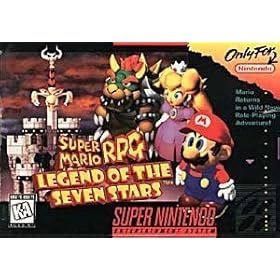
Super Mario RPG : Legend of the Seven Stars : Predictably enough, an RPG. Based in the Mario universe nonetheless.

Story : Bowser kidnaps the Princess. Ever the possessive boyfriend, Mario comes to stop this guy that dare ask out the Princess behind his back. He discovers that he went to the right castle on the first try and quickly comes to the rescue, only for some giant sword to plummet from the sky and set forth in motion a series of events that is the adventure of Super Mario RPG. What I like about the Paper Mario games and especially this game is the light-hearted sense of self-parody, as this game does a fine job of acknowledging all the odd nuances of the Mario universe and cleverly pokes fun of them, something that we can all wish the new Sonic RPG should do to the Sonic mythology but probably doesn’t.

I’ll get all the negatively out of my system right now.

Cons : By the second half, magic attacks are all but obsolete. The isometric camera makes certain jumps odd and challenging to attempt. RPG veterans who eat Disgaea-esque Nippon Ichi RPGs for breakfast will never be tested in this game.

Alright, now to stick a rod of praise up this game’s arse. Super Mario RPG is an RPG for the common folk, one that doesn’t beg you to grind away in areas for several hours to beat a boss or look up a strategy guide to discover what elemental attacks buffered with what attack modifiers will work in what situations. There usually isn’t a lot of strategy that goes into combat, but at the same time, the concept of having to time your button press at the right moment to increase damage means you won’t fall asleep thrashing the same goomba/frog thingy troupe of enemies over and over, and it helps that the fights themselves move at a more brisk pace than in the Paper Mario games. Likewise, enemies appear live in the areas instead of randomly popping up so there’s less of the frustration of RPGs past. You can avoid fights if you so chose to, but you’d best take plenty on as to keep your characters adequately leveled.

Hmmm…I’m realizing now that it’s harder to write a lengthy review for a game I love than a game I hate. These older games have less to review about, which is why I guess so many reviews dedicate paragraphs to graphics, audio, controls, some cliché introductory paragraph detailing the history of a franchise that often praises said franchise like it has some kind of royal heritage. I can’t think of too many games I’ve replayed more than this one, and I think it easily stands the test of time so it’s a definite must-have for Wii owners. Even if you don’t like RPGs, Super Mario RPG had a gateway drug-like effect on me that later got me hooked on Chrono Trigger, then later harder drugs like Xenogears and Dragon Quest…well whatever number the Playstation 2 Dragon Quest was. So it could have the same effect on you too. What else can I praise…?

Pros : Mario’s pantomiming ability, memorable cast, remained unaltered from its original release.

Okay, before I give this game 5 stars and move on, I do have one thing to say. I tend to wonder why Super Mario RPG has been ignored by Nintendo for so long. On one hand, I’m glad to see that it hasn’t been re-released and needlessly altered like any of the Super Mario Advance games, which got George Lucas-like tweaks like voice samples that didn’t fit in the original game. On the other hand, Geno, Mallow, and the rest of the Mario RPG universe has been left alone by Nintendo, a company that loves to relish in nostalgia by repackaging its characters in its tennis games, golf games, pinball games and especially the Super Smash Bros series. Is it because Square developed the game? If there’s some legal issue because of that, I would imagine it would’ve been dealt with being that the two companies are on the same page and Square even developed the Mario Basketball game. Or is it out of pride, seeing that some of the greatest original characters and perhaps the greatest storyline to ever come out of a Nintendo franchise were conceived by a studio that existed away from Nintendo? The Paper Mario games are valiant efforts to capture the same lightning Super Mario RPG struck in a bottle, but they lack the originality and often feel like dumbed-down versions of what wasn’t a very complex game to begin with.

5 stars

And almost certainly better than Sonic Chronicles.

Thursday, October 2, 2008

Mario Death Kart Wii


Mario Kart Wii : A not very realistic racing game where assorted Mario characters compete in races riddled with weapons, traps and too many weapons.

Story : In 2012, the Mushroom Kingdom economy collapses and life for everyone is not the same. Once a NASCAR champion, Mario, (Jason Statham), hits rock bottom and spent several years in prison. His life was improving and changing for the better after meeting and marrying Princess Toadstool (Janaya Stephens) and having a baby girl. Then the steel mill closes, and he loses his job. But that was not the worst thing to happen to Mario that day. Toadstool is brutally murdered, and he is framed for her murder. Mario is sent to Terminal Island, the worst and toughest for-profit prison in the country run by Warden Koopa (Joan Allen). She(?) has created the country's most popular pay-per-view sport, a kill-or-be-killed car race where the inmates race to win their freedom from prison after 5 wins. Every inmate driver is driving a monster car that they built which is loaded with machine guns, missiles, flamethrowers, napalm, and no rules. Warden Koopa convinces Mario to secretly take the place of the late 4-time superstar winner, Frankenstein, and wear his metallic mask in the race. If Mario wins just one race, he can go home to his baby daughter. To get to the finish line, Mario must kill his competition before they kill him.

(Synopsis of what would’ve been an entertaining story taken from IMDB)

Mario Kart Wii is the next logical evolution in the Mario Kart series. Or at least in somebody’s mind, it’s the next evolution of a lot of the ideas and concepts that the Mario Kart games have become most famous for. This individual came lead the Mario Kart Wii’s development team and began spouting his belief that MORE of everything is the way to go, not realizing that MORE of everything simply makes a broken foundation crumble under the weight of it all.

Perhaps this is why the Super Nintendo’s Super Mario Kart has yet to be released on the Wii Virtual Console. That game started the whole Mario Kart formula, with later renditions trying to turn up the volume of chaos that happens within races by adding more players, more items, more cars, more ways to get a speed boost, more obstacle-ridden tracks and so forth. But perhaps Mario Kart was more fun without all of the aforementioned noise, where only you and possibly one other player could use the overpowering items and AI challengers fought back using only basic items and driving skills, where you’d be lucky to collect more than one power-up per lap and drifting was only a strategic on turns and not the entire track.

You can either call the way Mario Kart games have changed over the years an evolution or a degeneration, in that with the onset of more players, more AI opponents whom have access to the same crippling items you have and more varieties of the lightning bolt. Mario Kart Wii feels like the pinnacle of this evolution and degeneration. Playing in the Grand Prix on 150cc against 11 other AI opponents is a real test of luck, as your success in each race will depend on you not getting pelted by blue shells, POW blocks, lightning, red shells, that blooper thing, and getting passed by enemies using the star or its two new variations, the bullet and giant mushroom.

This problem is lessened by the addition of online play. I’ll admit that at first I was thrilled by Mario Kart Wii’s online system, if just because it was fantastic in comparison to the embarrassment that is Super Smash Bros Brawl’s online system. You can play in either grand prix races or battle mode online with up to 12 players, and being that the odds are against a single online session amassing 12 players, you therefore get pelted with less blue shells and thus can actually have some more fun playing online with just 6 people. How many games can claim to be more fun online with less people involved? But quickly the faults of Nintendo’s online system show their faces, as the options to play with friends or strangers are once again kept separate. Maybe you reside in some freak part of America (Silicon Valley? Wherever it is Nintendo of America calls home?) and have an entire social network of Wii owners in your neighborhood, but I tend to think it’s an incredible coincidence that I know two other Wii owners, and I know most Wii owners aren’t that lucky.

So maybe you’ll be able to have some pretty solid 3 man races with your friends online, but what about the battle mode? The Mario Kart Wii battle mode has evolved into a 6 on 6 team deathmatch ordeal. I like the idea in theory, but once again the over-censored joke of a service that is the Nintendo Wi-Fi Connection laughs in the face of this idea. There are no smaller maps or option to play a free-for-all, so those 3 man games with your buddies aren’t going to be very thrilling. Your enjoyment of this mode will depend on how much you look forward to playing with 11 other people. It can be fun, perhaps the highlight of my Mario Kart Wii experience, but this feature, and all of the above online features, are all hampered by the complete lack of voice-chat support. No one is (hopefully) playing Mario Kart Wii for online ranking, so part of the multiplayer experience is laughing and screaming because your buddy was lame enough to actually hit a banana peel, and Nintendo has once again deprived that from us out of fear of little kids hearing any sort of profanity. (Never mind how freaking Pokemon on the DS has microphone support like that’s anymore of a mature audience-targeted game)

So, just like Smash Bros Brawl, you’re enjoyment of Mario Kart Wii will depend on how many of your friends you can get over for some multiplayer fun. I’d argue that in that sense, Mario Kart Wii makes a better party game than said Brawl since it’s more accessible. It’s easier to explain to someone “go to finish line before others” than it is to explain that pressing up and B at the same time yields a super attack that’ll keep you from falling off a cliff. Oh, about those Wii-specific controls…I actually enjoyed using the Wiimote to steer. I was never big on the idea of spending $150 on a video game steering wheel so I appreciate the option. In a change of pace from one Wii game too many, the option of using traditional, non-motion based controls is also prevalent. It’s not particularly accurate, the Wiimote steering, and you’ll probably go off-road more than you’d like, but unless you’re obsessed with time trial scores, odds are having perfect steering isn’t too relevant when you’ve got a red shell going up the ass every few turns.

Pros : I’ll admit, even though it’s ultimately an unnecessary piece of plastic, that I like using the included steering wheel shell. It feels comfortable, and I won’t hold it against you if you decide to buy more than one for your friends. Bring it to Wii parties so people won’t spend so much damn time on Wii Sports.

Cons : Of all the “retro courses” to include from Mario Kart 64, why Skyscraper? For $10, Mario Kart 64 on the Virtual Console is just as good of a multiplayer game anyways so you could save some money in that regard.

3 stars

Super Smash Bros : Brawl


Super Smash Bros Brawl : Some kind of fighter/platformer hybrid where players control a variety of characters from Nintendo’s past and battle each in some kind of King of the Hill-style of cartoon combat. Along the way, Nintendo will pat itself on the back a lot throughout the game.

Story : Oh yes, this one has a storyline, based in the new single-player campaign “The Subspace Emissary.” Apparently, the Nintendo mascots were engaging in some kind of friendly tournament popular enough to sell out the Tokyo Dome, only to be interrupted by an army of ROBs (the robot toys that plugged into your NES and dicked around according to what happened in 3 or 4 games) who use tactical nuclear strikes and special guns to transform Nintendo’s golden cows into statues. On the surface this appears to be the work of some bizarre Legion of Doom-like alliance of all the Nintendo villains but in truth is the work of one of the lamest “ultimate evil force” characters ever concocted. It’s as someone at Hal discovered a stray copy of The Watchmen, thought it was some small time independent book and that no one would notice if they ripped off a certain blue character. Oh, and the story sucks. There are several smaller subplots but the lack of dialog fails to give any depth to what’s going on, assuming most people will just geek out over seeing Pikachu and Samus Aran on the same team.

“The Subspace Emissary” is an example of SSBM’s attempt to produce as many new features as physically possible in an attempt to produce the most impressive press releases physically possible. I don’t think any other game at the time sounded more beefy in previews than Brawl. IGN may have spent more time typing stories about Smash Bros Brawl than most people will spend playing it…or any single game in general. However, in its attempt to be so ambitious, perhaps the developmental efforts that went into Brawl were too spread out, leaving most of these new features to falter. The aforementioned Emissary mode for example; besides the dull story, almost every level is the same series of uninteresting platform jumping and enemies all too blatantly ripped out of Kingdom Hearts. Fighting these doll-like…things gets old after the first stage, and you’ve got about 10 hours of fighting them before you reach the final boss and unlock Sonic The Hedgehog (yes, you have to unlock the two most prominently advertised features on the back of the box, Sonic and Metal Gear’s Solid Snake.) I found it cute and novel when the game filled the levels with goombas and koopas, and perhaps diversifying the worlds with enemies from Nintendo canon instead of the Heartless would’ve helped make this gameplay mode more interesting, but alas, it ultimately serves as a chore players are forced to go through to unlock the hidden characters and impress their friends at parties.

So right off the bat, the game strikes out at attempting to create an interesting single-player campaign. There’s also a much-publicized attempt at online play. The Wii’s online play already suffers from Nintendo’s need to protect kids playing online from stalkers and profanity with a lack of voice chat and the whole friend code system (which begs the question of why the ESRB included a message at the beginning of the game warning that they hold no responsibility over online play). Fair enough, but for some bizarre reason the game restricts your options when playing with strangers. You’re essentially limited to 2 minute timed battles, where the winner is usually whoever grabs the all-powerful Final Smash orb first. The ability to customize match rules is limited to playing with friends, and odds are the only friend codes on your system are going to be codes of people you know in person and thus can PLAY TOGETHER in person anyways, thus begging the question of why bother incorporating online play in the first place.

Many of the other new additions are minute. The Stage Editor is too barebones, only allowing you to make the most primitive and visually dull arenas to fight in. It feels useless when most people will wind up using Final Destination as their tournament setting or …every other stage for fun. (It’s worth mentioning that most of the levels in the game are clever in design and that whoever thought making an arena out of the third level of Donkey Kong should get some kind of promotion for his or her efforts.) There’s some kind of new sticker system which is essentially the same as trophies from the last game but…well, not as interesting and thus leaves you wondering what the point is. Trophies and stickers are unlocked throughout all the game modes but can be obtained the fastest through some weird shooting mini-game that randomly throws out trophies and ensures that only players who invest several hundred hours into the game will actually see all of the game’s content. The controls and general gameplay ideas are all but unchanged here, with the one new addition being the previously mentioned “Final Smash” attack. Final Smashing involves an orb that floats around the screen every now and then, and whoever successfully destroys it gets an overpowered, often screen-covering attack that racks up several instant-kills and in a timed match, usually translates into an instant victory. Thankfully, these can be turned off.

Otherwise, the core gameplay is intact. The controls are more accessible than most every fighter on the market, but at the same time, the control concepts (namely the notion of pressing different directions with the same button yielding completely different attacks) are too abstract to make this game pick-up-and-play friendly for newcomers. This is not a party game unless your party comprises of a bunch of SSB veterans who’ve been playing this franchise since its inception. For me, Brawl’s greatest strength lies in the way it handles its cast of characters. Being that most of the characters originated in 2D platformers and the game itself is a platformer disguised as a fighting game, most of the characters handle like you’d imagine them to, adding to the game’s goal of being a demented form of fan service. Kirby still floats around like a helium balloon, Wario fights like a soccer hooligan, Sonic jumps and speeds around the stage like a mosquito (and inflicts as much damage as one), Solid Snake tactically plants explosives and sets up traps, and Diddy Kong is a scrawny little monkey who can tactically plant banana peels (and becomes obsolete once you unlock Solid Snake and opt to use C4 over banana peels).

Ultimately, Super Smash Bros Brawl succeeds with flying colours in the areas that the series has always succeeded in; being an entertaining offline multiplayer game for fans of previous installments, and Nintendo giving itself one big $50 pat on the back. However, the game fails at pretty much every attempt to be more than that, and unless you have several friends who also love the franchise (or love it when Nintendo pleasures itself in their face) then you won’t be spending too much time playing it after you’ve forced yourself to unlock all the hidden characters.

Pros : The rare case of a fighting game where most of the new characters feel fresh and not retreads of past characters. Makes no attempt to use Wii-specific motion controls.

Cons : The main theme, complete with symphony and choir, feels too self-serving and is too grand in scale for any game with Pikachu in it. At the end of the day, it’s still a game about Nintendo loving itself. Fanboys will argue over what character should’ve been included from now until the next game comes out.

3 1/2 stars

Wednesday, October 1, 2008

Mega Man 9 (and another game too!)


Mega Man 9 : A 2D side-scrolling action game inspired by the NES Mega Man games. Well, inspired to the point that even the graphical glitches have been mimicked as well.

Story : Dr. Light has been framed and Mega Man has to prove his innocence. There seems to be more dialogue in this game than in the Mega Man games that inspired it, though the cutscenes are all inconsequential anyways. Predictably, any attempt to shake up the plot is meaningless as just like all the Mega Man games on the NES, Dr. Wily is the real villain, though not as predictable is Dr. Light’s disdain for artificial life, much less the environment. You can skip all the cutscenes anyway.

This is a tricky review for me to write because Mega Man 9 feels like a game that was custom-tailored for me. I’m an adamant fan of the original Mega Man games, not so much for their ingenious storytelling but rather for their mostly exceptional gameplay. Likewise, I lean towards the earlier Mega Man games because the limitations of the original Nintendo system held back the artist’s original vision; I could enjoy the game without thinking that I was playing a terrible Astro Boy ripoff. Later attempts in the franchise to flesh the characters out or reinvent the franchise typically end in a series of anime clichés and contrived, predictable stories that were more frustrating than intriguing. How many times has Zero died?


Int’l Creations, the developers of Mega Man 9, know what makes the original games good but find other ways to bog down the concept. Their last attempt at the franchise was the modestly underrated Mega Man ZX Advent on the DS. That was a great game in the areas that a Mega Man game normally excels at: difficult stages that can be accomplished with practice, tough bosses with tricky patterns that players need study to defeat them, and interesting power-ups, in this case taking the form of the ability to transform into the previously mentioned boss characters. The problem was that they also added a very convoluted, text-ridden, boring and annoying storyline and strung the levels together with a useless hub and a barely-there Metroid-style need to backtrack to progress, both of which ruined the pace of the game. Despite all these issues, ZX Advent is a stellar game that comes highly recommended for platformer fanatics.

3 ½ stars

Okay, so I had to review another game to get a point across about Mega Man 9. Being that Mega Man 9 is supposed to mimic the 8-bit style of the original games, all that overworld nonsense and bad story is ripped out and you’re left with a straight platformer. If anything, you get the sense that the developers really studied the source material, because I could argue that the level design here is even sharper than in those past games. The powerups you obtain from bosses actually become useful throughout the game through carefully-conceived scenarios, and there are a handful of surprising stage ideas to throw veterans off guard. The bosses here can straight trample you if you’re not careful…or don’t have their weakness weapon. Speaking of which, the art direction here is equally bizarre, introducing you to the series’ trademark unorthodox enemy-robot-things with googly eyes. A flower robot presents one of the toughest battles in the game.

Like the past games, Mega Man 9 isn’t long when you know what you’re doing, and once you’ve gotten the hang of things, a play-through of the whole game should take about an hour. But for the Youtube video-posting speed runner type of gaming freaks, the option to run through the whole game or individual stages timed, along with some of the most absurd list of in-game achievements will give people something to brag about. And on top of that, the game is only $10, so say what you will about the developers going cheap with going for graphics and audio that would be considered cutting edge in 1985, but I prefer this than being flossed for $40-50 for certain re-releases like ohhhh…Kirby Super Star or Chrono Trigger on the DS.

If you like Mega Man games, your mind should already be made on whether or not you should buy this game, as it could very well be the best game in the entire series. If you haven’t, well you have to ask yourself whether or not you like to die, because if you step into this game, you are going to die and you are going to die often. But this is a good kind of death, one where you’ve progressed a bit further from the last time you died, and eventually your corpse is filled with a euphoric type of embalming fluid from the sense of satisfaction because you just beat Concrete Man with your regular gun. This is challenge, but it’s the right kind of challenge in a video game.

Pros : VERY creative boss ideas. Hornet Man? Galaxy Man? Jewel Man? Splash Woman? What inspires scientists to make such machines?

Cons : Admittedly, it is pretty lame that you have to pay to get extra difficulties.

4 ½ stars

And I do hope that some of the older developers take the same cue as Capcom when it comes to “updating” their franchises. Like say, for example, SONIC.

Grand Theft Auto 4


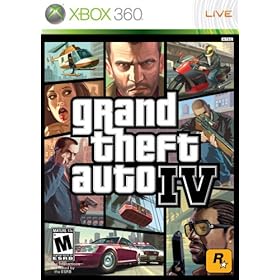
Grand Theft Auto 4 : A city-based action game comprised mostly of shooting things, driving things and driving over things, combined with the immigrant experience.

Story : Niko Bellic has immigrated to Liberty City on brother Roman’s promise of living the American dream (and other reasons) only to realize that Roman is in debt to bad people. Fortunately, Niko has military training and a very dark past, and after his initial guilt trip of his first murder and crime (which completely undermines the likely possibility that the player controlling Niko was probably running over pedestrians and beating up strangers on the street to death for money before even reaching that mission), attempts to help. Like past Grand Theft Auto games, most of the characters are very strong and fun to watch, and Niko himself is a great protagonist, easy to sympathize for but also has perhaps the video game industry’s strongest love of sarcasm. But that said…

…when Grand Theft Auto 4 was first released, it received almost universal praise for many reasons. However, about a month or two later, some kind of universal backlash rose and people started calling it overrated, poorly written, with the worst ending in all of gaming. Part of that may be people trying to be trendsetters and go against the grain of the gaming community by slagging what was once a guaranteed game of the year candidate, but part of that is also from people overreacting to said ending. The ending isn’t terrible per say, just not well set up. The game’s climax appears out of nowhere with no build up and thus no sense of shock, leaving no emotional weight. It also doesn’t help that there’s no checkpoints in the lengthy final mission, but the final mission itself isn’t too challenging in itself anyways so whoever whines about that can bugger off. The story as a whole feels poorly paced. You’ll forget all about it most of the time, and when a major plot event happens, it’s too sudden and feels meaningless. It’s not to say the game has a terrible storyline, it’s just that for a story that tries to take itself more seriously than in past GTA games, it has nowhere near as much impact as its predecessors.

There’s one nitpick about the story I’d like to get out the way too; the game’s use of some kind of mysterious government agent/Area 51 figure as a means of connecting certain plot elements. Any praise that the gaming media may have given Grand Theft Auto 4 about an “Oscar-worthy story” should’ve been thrown out the window when he stepped in the picture.

But on a positive note, like its predecessors, the story excels in the parts where it doesn’t take itself too seriously. The characters are all very likeable, and just like with past games, are clever send-offs to a variety of criminal stereotypes. The characters are even more fleshed out by the player’s ability to call them at any time on your cell. Yes, one of the most vaunted features in this new game is Niko’s virtual social life; he can call up a character to hang out or date, learn more about said character along the way, and either play some kind of bowling/pool minigame, get virtual drunk, or so forth. Different characters have preferences on what they prefer to do, and most will give the player some kind of perk if they like you enough. Great feature in theory, but just like a real social life, the catch is that you have little control over when they want to hang out. Say you’re in the mood to just do story missions or side quests and someone calls you up. If you don’t agree to hang out, you lose “friendship” points with that person. This happens more often than you’d like it to, and it always feels cheap when it does.

Grand Theft Auto 4 feels like some kind of gaming super heavyweight. The production values seen here far exceed anything that’s on the market, to the point where it almost seems unfair to all the other games that are available. Niko always has something to say for every situation and he rarely repeats lines, whether it involves killing strangers or calling 911 on his phone and giving the name of the intersection he’s on so you can hijack the incoming cop car. Many of the missions contain some kind of firefight sequence taking place in a unique set piece area, and despite the length of the story mode (about 25-30 hours), I never found myself thinking that this was getting stale. Very few missions feel like duds. A game that can be that long without some drawn out filler seems like a rarity in this generation. There’s a wide variety of gameplay mechanics, from the obvious mainstays of driving and killing to calling a taxi or surfing online dating sites or purchasing a new pair of slacks, and while it all helps to make the game feel less like a game than a virtual world, it also means that there’s more that has to be explained to the player. The first couple hours of story missions are all boring tutorial missions designed to slowly explain everything. On the first play through, this is annoying and you’ll find yourself wondering when the game turns down the suck and turns up the fun. But say you decide you want to play the story mode all over again…you can see the problem that comes up.

But I digress. Going back to the theme of the game’s heavyweight champion of the world status, Grand Theft Auto 4 successfully creates the greatest virtual world in any medium, and odds are against ever seeing a virtual world anywhere near as fleshed out in any medium for years. Even Massively Multiplayer Online RPGs can’t compare. GTA4 is the only game that has the following: a virtual set of radio stations and television stations with original programming, a virtual internet, a virtual phone system with a variety of numbers, virtual restaurants, bars and establishments, all within the confines of a city where citizens, buildings and cars are all placed in a believable manner that rarely repeats (though you’ll wonder how the preacher in front of your apartment whom you just killed came back to life.) And what’s even better is that all of the above is meant to be some form of parody or satire of real life. Whether it’s the ability to purchase hokey ringtones or the conservative-slanted political radio show, all of Liberty City has been designed to be some kind of spoof on reality.

So what would be the best way to sum up Grand Theft Auto 4? Well, the first few hours of the game are lame, the last few hours of the game are also lame, but the middle 20-odd hours in between embody some of the best times you’ll have with a game all year. This middle 20 hours sometimes feels so good that it’s almost unfair to other games, like you feel bad for using Grand Theft Auto 4 as the measuring stick for all future releases. So it should go without question that this is a game worth purchasing. Well, I guess unless you’re an extreme conservative who’s easily offended. Or you hate Russians.

Pros : I didn’t mention this at all in the review so I’ll say it here that the online multiplayer in Grand Theft Auto 4 is a lot of fun. It’s pretty much what you’d imagine online multiplayer in a GTA game to be, where all the gameplay modes take place within the confines of the city, but even standard gameplay conventions like deathmatch are freshened up when streets filled with cars begging to be hijacked are factored in.

Cons : Not enough attire choices for your online avatar.

4 ½ stars